Remodeling leads: where good ones come from, and which to pay for.
Most kitchen and bath remodelers don’t need more leads. They need more of the right ones: homeowners with a real project, in the towns they serve, with a budget that fits. This guide covers where those homeowners come from in 2026, how referrals, Google, Local Services Ads, Houzz and Angi compare, how to qualify and follow up, and what the numbers look like in a real remodeling account.
By Josh Turgut, Founder of ECHVOUpdated 15-minute read
The best leads are planners you help early.
Remodeling leads in 60 seconds
A good lead is a homeowner with a project you do, in your area, with a timeline and a budget that can work. Everything else is an inquiry, and the two need different handling.
How homeowners find remodelers: in early 2026, homeowners who hired a pro most often found them by having worked with them before or through a friend or family referral, 31% each [1].
They don’t shop around much: homeowners who hire contact 1.8 pros on average, and just over half contact only one [2]. Being the first credible name they find matters.
Paid sources aren’t equal: Angi sends each request to up to five pros [3]; Local Services Ads charge per valid lead and the homeowner contacts you directly [4].
Planners need patience: a kitchen takes months to plan, so fast replies and months of light follow-up turn early inquiries into projects.
Judge sources by cost per signed project, not cost per lead.
Gemini and Copilot open with the prompt copied. Paste it in to start.
What counts as a good remodeling lead?
A remodeling lead is a homeowner who has asked a remodeling company to contact them about a project. A good remodeling lead has a project you actually do, lives in a town you serve, and has a timeline and a budget that can work. Everything else, from sales calls to jobs you don’t do to people collecting ideas with no plan yet, is an inquiry.
The difference matters because most lead sources report inquiries, and most remodelers pay for leads as if every inquiry were the same. They aren’t. A kitchen and bath company should track five separate numbers:
InquiryAnyone who calls, texts or fills out a form. Includes tire-kickers, sales calls and jobs you don’t do.
Qualified leadA homeowner with a project you do, in your area, a timeline and a budget that can work.
ConsultationThey give you an hour in their home or your showroom. This is the number to grow.
ProposalYou priced it. Track how many you send and how long they sit.
Signed projectThe only result that pays the bills, and the one to judge every lead source by.
Five stages, five different numbers. A lead source that sends lots of inquiries and few consultations is cheap on paper and expensive in practice.
The rest of this guide is about raising the middle of that chain: more consultations from the same number of inquiries, and more inquiries from sources that tend to produce consultations.
How homeowners find and choose a remodeler
Start with how homeowners actually behave. The most recent data says they lean heavily on people they trust, and they don’t contact many companies:
31%of homeowners who hired a pro went back to one they’d worked with before.
31%found the pro they hired through a friend or family referral.
1.8pros contacted, on average, by homeowners who hired one. Just over half contacted only one.
64%put recommendations or references among their top three reasons for choosing a pro.
Sources: HIRI Homeowner Project Activity Tracker, Q1 2026, 1,198 U.S. homeowners, all project types [1]; HIRI, 2023 data [2]; Houzz survey of 2,866 Houzz users, 2024 [5].
Two things follow. First, past clients and referrals are still the two most common ways homeowners find the pro they hire, so they deserve a system, not luck. Second, even a referred homeowner checks you out. In an earlier Houzz survey, more than 60% of homeowners said they research a pro online even after a word-of-mouth referral [6]. If your reviews, photos and website look thin, a referral can stall before the first call.
When homeowners do pick a remodeler, they’re choosing a team for a big, personal project. In Houzz’s 2026 studies of renovating Houzz users, 89% hired at least one pro for a bathroom project [7] and 87% for a kitchen [8]. The factors they rank highest, after recommendations, are experience with a similar scope of project (47%) and pricing that fits their budget (39%) [5]. That is a useful checklist for every page, ad and first phone call: show similar projects, and be honest about price ranges.
Why remodeling leads feel harder to get in 2026
If leads feel slower this year, the industry numbers agree. Remodelers aren’t in a slump, but they aren’t in a boom either, and homeowners are taking their time:
NAHB remodeler index62Third-quarter 2026 reading; the leads and inquiries part of the index was 53 [9].
Kitchen & bath index52.7Second quarter 2026; NKBA members expect full-year activity down about 2% [10].
Remodeling spending$519BProjected U.S. homeowner improvement spending by mid-2027, growing about 0.5% [11].
No quote yet78%of homeowners with a project in mind hadn’t received a single quote, Q1 2026 [1].
Steady, not booming. Index readings above 50 mean more remodelers rate conditions good than poor. The Harvard projection covers all owner-occupied improvements and repairs.
NAHB’s remodelers chair put it plainly in the October 2026 release: “Remodelers also report that economic uncertainty is making some potential customers hesitant to move forward with projects” [9]. And the homeowners who do move forward plan carefully. Three in four renovating Houzz users set a budget before they start, 37% still went over it, and more than a third paid for part of the work with credit cards, up five points from the year before [12].
In a market like this, every good lead is worth more, and losing one to a slow reply or a confusing website costs more. The remodelers who win are the ones who show up early in the planning, make it easy to ask a question, and stay in touch until the homeowner is ready.
Remodeling lead sources compared
Here is how the common sources of kitchen and bath leads compare on cost model, ownership and speed. Prices and terms change, so check each platform’s current terms before you sign:
No single source wins on every column. Referrals and SEO are the cheapest per signed project once they’re built, but they take time. Google Ads and Local Services Ads are fast and send homeowners straight to you. Marketplaces are the fastest to switch on and the easiest to switch off, which is exactly why they’re rarely the cheapest over a year.
Leads you own vs. leads you rent
The most useful way to sort lead sources isn’t paid versus free. It’s whether the lead, and everything it builds, belongs to you:
Leads you rent
Lead services and marketplaces
Fast to switch on, and gone the day you stop paying.
Often shared with other remodelers
The platform sets the price and the rules
Reviews and history live on their site
Good for filling gaps and testing an area
Leads you own
Referrals, your profile, your website
Slower to build, and they keep working when you stop spending.
The homeowner contacts you, not five pros
Your reviews and project photos keep adding up
Past clients and their friends come back
Lower cost per signed project over time
Rent to fill the calendar, own to build the business. Most healthy remodeling companies use both, and slowly shift the mix toward leads they own.
Google Ads and Local Services Ads sit in between. You pay for them, but the homeowner calls you, the conversation is yours, and with Local Services Ads the reviews shown are your Google reviews. That’s why most remodelers get more lasting value from a dollar spent on Google than from a dollar spent on a shared lead.
Turn referrals into a system
Nearly every remodeler says most of their work comes from referrals, and few have a process for getting them. The data backs the instinct: a prior relationship and a friend or family referral were the two most common ways homeowners found the pro they hired in early 2026 [1]. A simple routine makes those referrals steady instead of lucky:
Finish wellClean punch list, a walkthrough and a thank-you. Referrals start here.
Ask at the walkthroughAsk who else is planning a project, and for a Google review.
Make it easyA card, a short link and a few project photos they can forward.
Stay in touchA check-in at 6 and 12 months, plus your new projects a few times a year.
Say thank youThank every referrer, whether or not the project signs.
The referral loop. Most remodelers get referrals by accident. A simple routine turns them into a steady source.
Build a list of every client from the last five years, with the project, the town and the date. Check in after six and twelve months, send a few emails a year with your newest projects, and ask for a Google review while the room still feels new. Designers, architects, showrooms and suppliers can be a second referral stream: on Houzz kitchen projects of $50,000 or more, 34% of homeowners hired a kitchen designer [8], and those designers need remodelers they trust.
Keep referral rewards and reviews separate. A thank-you for a referral that becomes a project is common, but don’t tie any reward to a review. Google prohibits paying or rewarding customers for reviews [15], and the FTC’s rule on consumer reviews bans incentives that depend on a review being positive or negative [16].
Google: your profile, website, ads and Local Services Ads
Google is where most homeowners go once they start looking beyond friends and family, and it offers four different ways to show up:
Your Google Business Profile puts you in the map results for searches like “bathroom remodeler near me.” It’s free, and it’s where your reviews live.
Your website ranks for the planning searches, like costs and ideas, that come months before the hiring search. Our remodeling SEO guide covers both in detail.
Google Ads puts you at the top for the exact projects and towns you choose, and you pay per click. Send each ad to a page about that project, not your homepage, and add negative keywords for DIY and job searches.
Local Services Ads are available in the U.S. for kitchen remodeling and bathroom remodeling [17]. You pay for each valid lead, and Google says prices vary by location, job type, lead type and bidding mode [4].
Local Services Ads have changed a lot in the last year, and much of what you’ll read online is out of date. Since October 2025, Google has used one badge, Google Verified, in place of Google Guaranteed and Google Screened [18], and it ended the money-back guarantee that came with the old Guaranteed badge [19]. Google is also moving Local Services Ads into Google Ads as Performance Max campaigns with pay-per-lead goals: select home and storefront service businesses first, starting in August 2026, then service-area businesses without storefronts in late 2026, and remaining accounts in 2027 [20]. Our Local Services Ads guide covers what that means for remodelers.
Paid lead services: Angi, Houzz and Thumbtack
Lead marketplaces can fill a slow month or test a new area quickly. Before you sign, understand how each one charges and who else gets the same homeowner:
Angi: lead fees “change based on task, homeowner location, and demand for the work,” and each homeowner request is matched with “no more than five pros” [3]. Credits are offered for invalid leads under 45 days old, and not for leads on annual subscriptions [21].
Houzz Pro: software plans run $99, $199 and from $399 a month, advertising starts at $499 a month, and billing becomes an annual subscription after a 30-day trial [13].
Thumbtack: you set a weekly targeting budget and pay automatically for leads that match your settings [14].
History is worth knowing, too. In 2023 the FTC approved a final order requiring HomeAdvisor, which is part of Angi Inc., to pay up to $7.2 million to service providers over how it marketed its leads; the company didn’t admit wrongdoing [22]. That doesn’t make every marketplace a bad deal, but it’s a reason to track your own results instead of trusting a platform’s description of its leads. Our guide Is Angi worth it for contractors? goes deeper.
The math is simple. Add up what you spent on a source over three to six months and divide it by the projects it produced. If $1,500 brought 20 leads and 2 signed projects, that source cost $750 per project, whatever the price per lead looked like.
What the numbers look like in a real account
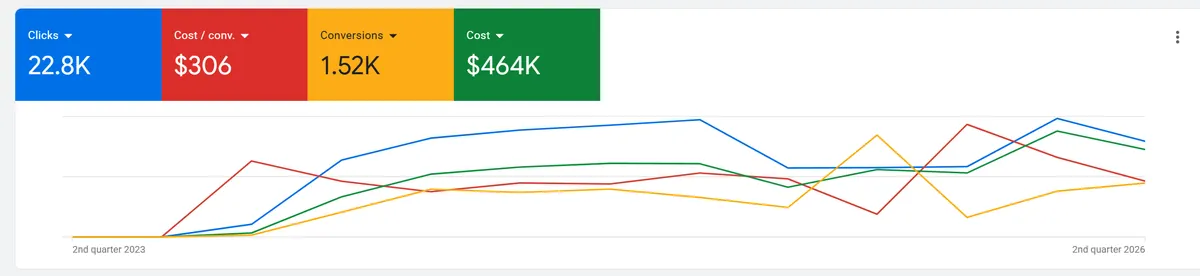
Here’s a real example. ECHVO’s founder runs the marketing for a kitchen and bath design-build company he’s affiliated with, and these are that company’s numbers. Your market, budget and close rate will differ, so read them as one company’s results, not a forecast:
Google Ads clicks22.8KQ2 2023 to Q2 2026, account data.
Tracked conversions1.52KCalls and forms counted as leads, on $464K of ad spend.
Cost per conversion$306Per tracked lead, not per signed project.
Organic visits a month7,390Up from 110, Ahrefs estimates, January 2024 to January 2026 [23].
Three years of paid search and two years of SEO for one kitchen and bath company. Ad figures are account data; organic visits are Ahrefs estimates. Over the same two years, the number of keywords the site ranked for in Google’s top three grew from 3 to 686.
The Google Ads account overview, Q2 2023 to Q2 2026. A kitchen and bath design-build company affiliated with ECHVO’s founder. On phones, swipe to see the full chart.
Three lessons carry over to most remodelers. First, a conversion isn’t a signed project: $306 per tracked lead only means something next to the close rate and the size of the jobs those leads became. Second, paid search kept the calendar full while SEO was being built. Third, the SEO work compounded: once project pages, cost guides and reviews were in place, organic visits kept climbing without a matching increase in spend.
Qualify leads without scaring off planners
Remodeling inquiries come from two kinds of homeowners: people ready to talk to a remodeler now, and people a year out who are building a budget. Both are valuable. The mistake is treating them the same, either by pushing planners into a sales appointment or by giving ready buyers a slow, generic reply.
Ask a few questions up front, on the form or in the first call:
What’s the project? Kitchen, primary bath, guest bath, shower conversion.
Where is the home? Town or ZIP code, so you can rule out areas you don’t serve.
When do you want to start? In the next three months, this year, or just planning.
What budget range are you considering? Offer ranges. Three in four renovating Houzz users set a budget before they start [12], so most can pick one.
How did you hear about us? Ask every time, even when you have tracking.
Then give each group its own door. “Book a design consultation” works for homeowners who are ready. Planners need a lower step: a cost guide with honest ranges, a gallery of similar projects or a visualizer that lets them see their own room in a new style. We built one for remodelers, the ECHVO AI Kitchen & Bath Designer, so we’re biased, but the principle works with any honest tool: help planners early, and they’ll remember who helped.
Follow up fast, then follow up for months
Speed still matters, even for a project that won’t start until spring. In a Harvard Business Review analysis of 1.25 million sales leads at 42 U.S. companies, firms that tried to reach a lead within an hour were nearly seven times as likely to qualify it as firms that waited longer, and more than 60 times as likely as firms that waited a day or more [24]. That data is older and not specific to remodeling, but the lesson holds: the first reply sets the tone. Our speed to lead guide covers how to answer faster without hiring.
After the first reply, remodeling follow-up is a long game. Many homeowners with a project in mind haven’t even asked for a quote yet; in early 2026, 78% hadn’t received one [1]. A short, useful touch every few weeks keeps you on their list:
Tuesday, 10:42 AM
Hi, we’re thinking about redoing our primary bath next spring. Not sure on budget yet.
Thanks, Dana! This is Mike from [Company]. Spring is a great time to start planning. Want our bathroom cost guide, or a quick call this week to talk through ideas?
The guide would be great.
Here it is: [link]. I’ll check in next month. Reply STOP anytime to opt out.
Answer fast, even if the project is months away.
Offer two doors: a planning resource for planners, a consultation for the ready.
Set the next touch before the conversation ends.
Text only with permission, from a registered business number, with an easy opt-out.
Follow-up for a planner, not a buyer. An example of a fast, low-pressure reply that keeps a long-horizon lead warm.
Put every lead into a CRM with its stage and next follow-up date, so nobody falls through the cracks when the office gets busy.
Judge every source by cost per signed project
Cost per lead is the number lead sellers want you to look at. Cost per signed project is the one that tells you whether a source is worth it. Track these for every source, every month:
What to track
Why it matters
Inquiries by source
Shows which channels people use, not which ones pay
Qualified leads by source
Filters out wrong jobs, wrong towns and sales calls
Consultations held
The best early sign a source sends real projects
Proposals sent and average size
Shows whether a source brings the projects you want
Signed projects and contract value
The result everything else should be judged by
Cost per signed project
Spend on a source divided by the projects it produced
Response time
How long a new lead waits for a real reply
Look at three to six months at a time, because remodeling decisions are slow. If a source sends many inquiries but few consultations, it’s probably sending the wrong projects or the wrong budgets. If it sends consultations that don’t sign, look at your proposals, your follow-up and your prices before you blame the source.
A 90-day plan for better remodeling leads
If your lead flow feels random, this is the order we’d work in:
Days 1–30
Measure
Tag every lead by source in your CRM, from the first call.
Add call tracking and form tracking to your website and ads.
Add project type, town, timeline and budget range to your contact form.
Pull a list of every past client from the last five years.
Write down your cost per signed project for each paid source you use today.
Days 31–60
Fix the leaks
Set a response goal: same business hour, every lead.
Build a follow-up schedule for planners: 1 week, 1 month, every 1–2 months.
Publish honest cost ranges for kitchens and baths in your area.
Start the referral routine at every final walkthrough.
Check in with past clients and ask for Google reviews.
Days 61–90
Shift the mix
Cut or cap the paid source with the worst cost per signed project.
Put that budget into Google Ads or Local Services Ads for your best project types.
Publish three project pages from recent jobs.
Meet two designers or showrooms who send work to remodelers.
Review consultations and signed projects by source, then repeat monthly.
A 90-day plan to get better remodeling leads. Measure first; you can’t fix a lead source you don’t track.
Be patient with the results. Faster replies and better qualification can show up in a few weeks; referrals, SEO and reviews build over months. Anyone who promises a fixed number of signed projects is guessing.
Common remodeling lead mistakes
Judging sources by cost per lead instead of cost per signed project.
Paying for shared leads with no fast follow-up, so other remodelers reach the homeowner first.
One long contact form, or one with no budget, timeline or town question at all.
Pushing planners into a sales appointment before they’re ready.
No system for referrals, past clients or designer relationships.
“$199 a month!” financing ads without the required details. Truth in Lending rules apply to contractors who advertise financing, not just lenders [25], and payment amounts trigger extra disclosures [26].
Lead-safe claims you can’t back up. EPA says firms can’t advertise renovation work covered by its lead rules in pre-1978 homes without firm certification [27].
Rewarding reviews or asking only happy clients[15].
Remodeling leads FAQ
What is a remodeling lead?
A remodeling lead is a homeowner who has asked you to contact them about a project. A good one has a project you do, in a town you serve, with a timeline and a budget that can work. Everything else, like sales calls, jobs you don’t do and people collecting ideas with no plan, is an inquiry. Track the two separately.
How much do remodeling leads cost?
It depends on the source and your market. Angi’s lead fees vary by task, location and demand, Google Local Services Ads charge per valid lead at prices that vary by location and job type, and Houzz Pro advertising starts at $499 a month on an annual plan. The number that matters is cost per signed project. In the account in this guide, Google Ads cost $306 per tracked lead over three years, which says nothing until you know how many of those leads signed.
Are exclusive leads better than shared leads?
Usually, yes. A homeowner who contacts only you is easier to win than one who was sent to up to five remodelers at once, as Angi does with each request. Shared leads can still pay off if you answer within minutes and close well, but judge them by cost per signed project, not price per lead.
Is Angi worth it for kitchen and bath remodelers?
It can fill gaps, but it’s rented, shared demand. Angi sends each request to up to five pros, sets lead prices by task, location and demand, and offers credits only for invalid leads. Test it with a capped budget, answer every lead fast and compare its cost per signed project with your other sources.
Do Google Local Services Ads work for remodelers?
They’re available in the U.S. for kitchen remodeling and bathroom remodeling, and you pay per valid lead, with the homeowner contacting you directly. Since October 2025 every verified business gets the same Google Verified badge, and Local Services Ads are moving into Google Ads in phases from August 2026 through 2027. They work best alongside a strong Business Profile, since your reviews come from there.
How fast should I respond to a remodeling lead?
Within the same business hour if you can. In a Harvard Business Review study of 1.25 million sales leads, companies that tried to reach a lead within an hour were nearly seven times as likely to qualify it as those that waited longer. Remodeling decisions are slow, but the first reply still sets the tone.
Should I ask for a budget on my contact form?
Ask for a budget range, not an exact number. Three in four renovating Houzz users set a budget before they start, so most homeowners can pick a range. Pair it with project type, town and timeline, and keep the form short.
Are referrals still the best source of remodeling leads?
They’re still among the most common. In early 2026, homeowners who hired a pro most often found them by having worked with them before or through a friend or family referral, 31% each. But most homeowners research a pro online even after a referral, so referrals and a strong online presence work together.
Sources
We link every fact in this guide to the page it came from. Survey figures cover the group each survey sampled, such as Houzz users or homeowners who recently hired a pro. Case study figures are account data from a company affiliated with ECHVO’s founder.
ECHVO is a marketing agency for contractors. For kitchen and bath companies, we run Google Ads and Local Services Ads, build the pages and profiles that bring in planners, and track every lead to the project it became.
We’ll look at your lead sources, ads, Business Profile, website and follow-up, then show you which sources to grow, which to cut and what to fix first. No cost, no obligation.
Send your website and the towns where you want more kitchen and bath projects.
Thank you. Your request has been sent, and we’ll be in touch to find a time to talk.
Something went wrong while sending your request. Please try again, or email info@echvo.com.
ECHVO · Privacy
Cookies on ECHVO.
We use cookies for analytics and advertising to understand visits and measure our campaigns. You can turn them off anytime. Read our Privacy & Cookies Policy.
Your preferences
These choices apply to optional tools connected to this site. You can change them later using Cookie settings in the footer.
EssentialNeeded to deliver and protect the website.Always on